Interactive Lessons

Integration

Theme 11
8learning outcomes6sub-items16applications

Outcomes of this theme

← Back to the overview
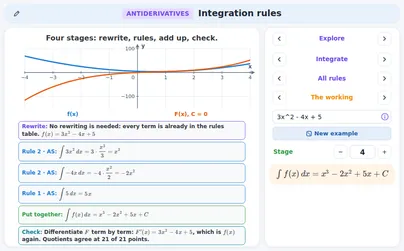
H2[Integrate xnx^n (excluding n = -1), and related sums, differences and constant multiples] Integrate ekxe^{kx}, 1x\dfrac{1}{x}, sin⁡kx\sin kx, cos⁡kx\cos kx and related sums, differences and constant multiplesFully covered

Part

  1. a[Integrate xnx^n (excluding n = -1), and related sums, differences and constant multiples]
  2. bIntegrate ekxe^{kx}, 1x\dfrac{1}{x}, sin⁡kx\sin kx, cos⁡kx\cos kx and related sums, differences and constant multiples

Supporting applications 2 applications

DfE content: p. 12

← Back to the overview
H5ACarry out simple cases of integration by substitution and integration by parts; understand these methods as the inverse processes of the chain and product rules respectively (Integration by substitution includes finding a suitable substitution and is limited to cases where one substitution will lead to a function which can be integrated; integration by parts includes more than one application of the method but excludes reduction formulae)No application yet

Part

  1. aCarry out simple cases of integration by substitution and integration by parts; understand these methods as the inverse processes of the chain and product rules respectively
  2. b(Integration by substitution includes finding a suitable substitution and is limited to cases where one substitution will lead to a function which can be integrated; integration by parts includes more than one application of the method but excludes reduction formulae)

There is no application for this outcome yet. It is taught as classroom work.

DfE content: p. 12
← Back to the overview
H7AEvaluate the analytical solution of simple first order differential equations with separable variables, including finding particular solutions (Separation of variables may require factorisation involving a common factor)No application yet

Part

  1. aEvaluate the analytical solution of simple first order differential equations with separable variables, including finding particular solutions
  2. b(Separation of variables may require factorisation involving a common factor)

There is no application for this outcome yet. It is taught as classroom work.

DfE content: p. 12
← Back to the overview
H8AInterpret the solution of a differential equation in the context of solving a problem, including identifying limitations of the solution; includes links to kinematicsNo application yet

There is no application for this outcome yet. It is taught as classroom work.

DfE content: p. 12