Interactive Lessons

Exponentials and logarithms

Theme 9
7learning outcomes24applications

Outcomes of this theme

← Back to the overview
F2AS[Know that the gradient of e^kx is equal to ke^kx and hence understand why the exponential model is suitable in many applications]Support only

No application teaches the outcome directly; supporting applications exist.

DfE content: p. 11

← Back to the overview
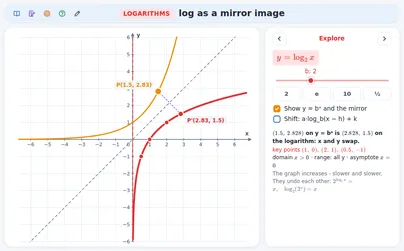
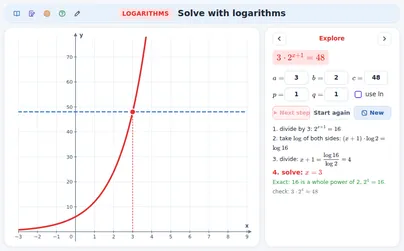
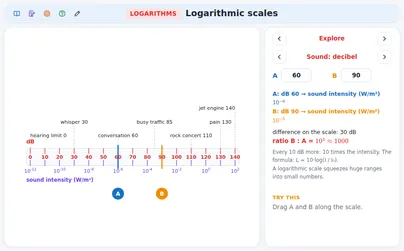
F3AS[Know and use the definition of log⁡ax\log_a x as the inverse of axa^x, where a is positive and x≥0x \ge 0] [Know and use the function ln⁡x\ln x and its graph] [Know and use ln⁡x\ln x as the inverse function of exe^x]Fully covered
← Back to the overview
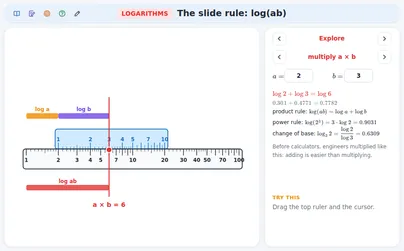
F4[Understand and use the laws of logarithms: log⁡ax+log⁡ay=log⁡a(xy)\log_a x + \log_a y = \log_a(xy); log⁡ax−log⁡ay=log⁡axy\log_a x - \log_a y = \log_a \dfrac{x}{y}; klog⁡ax=log⁡axkk\log_a x = \log_a x^k (including, for example, k=−1k = -1 and k=−12k = -\dfrac{1}{2})]Fully covered
← Back to the overview
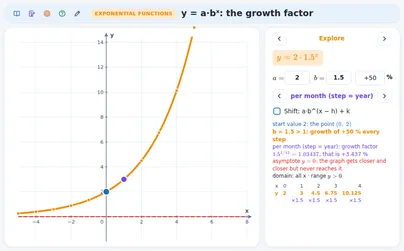
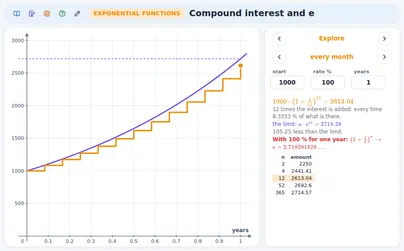
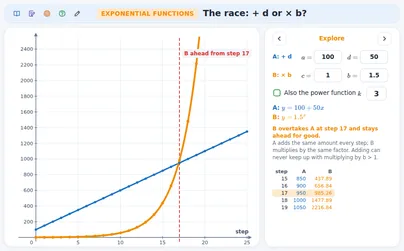
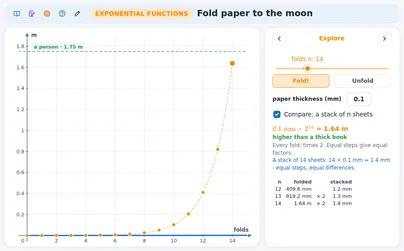
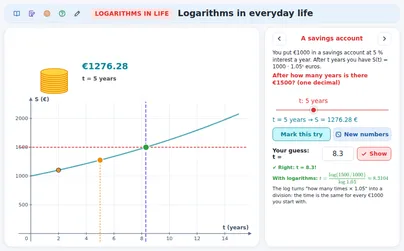
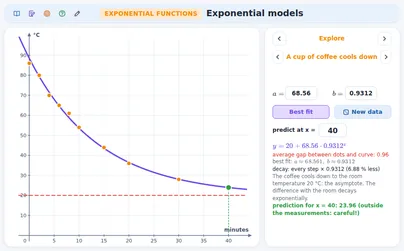
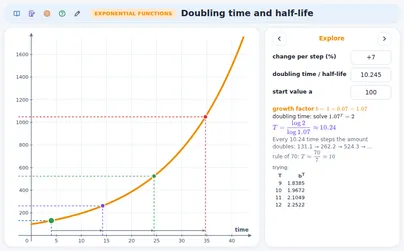
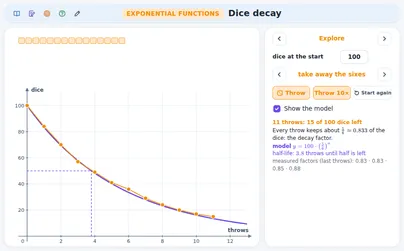
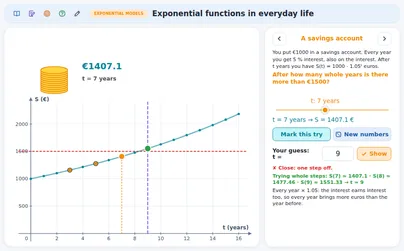
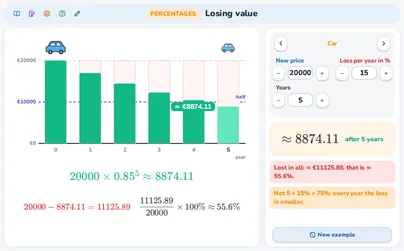
F7AS[Understand and use exponential growth and decay; use in modelling (examples may include the use of e in continuous compound interest, radioactive decay, drug concentration decay, exponential growth as a model for population growth); consideration of limitations and refinements of exponential models]Fully covered