Interactive Lessons

Functions

Topic 3
11learning outcomes18sub-items25applications

Outcomes of this theme

← Back to the overview
E3.1.1ExtendedIdentify a function's type, such as linear or quadratic, from its graph shapeFully covered

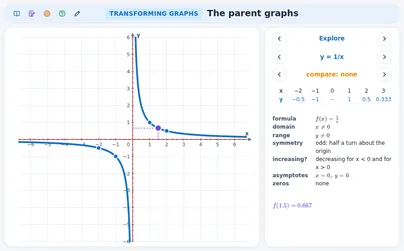
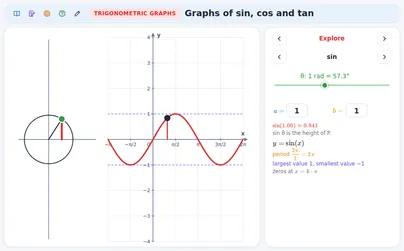
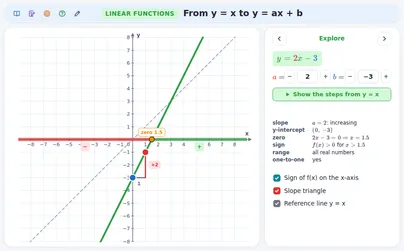
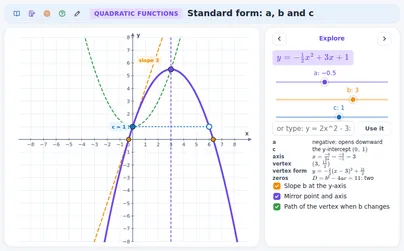
Graphs of functions

Details

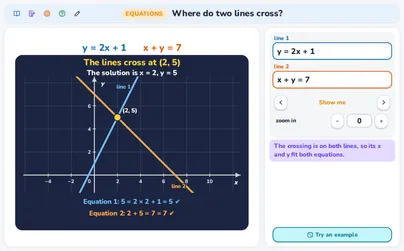
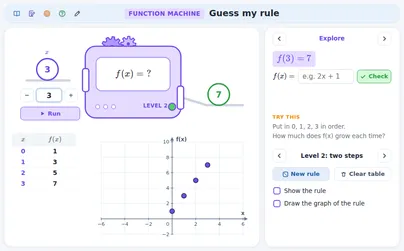
  1. alinear: f(x)=ax+bf(x) = ax + b
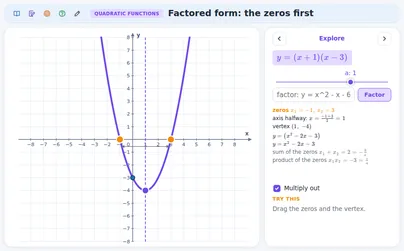
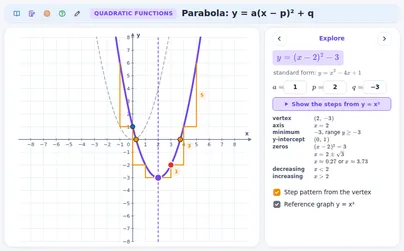
  2. bquadratic: f(x)=ax2+bx+cf(x) = ax^2 + bx + c
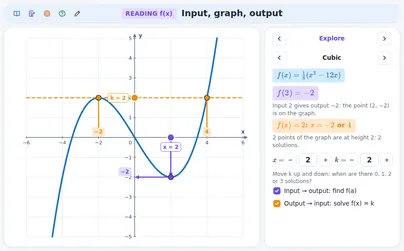
  3. ccubic: f(x)=ax3+bx2+cx+df(x) = ax^3 + bx^2 + cx + d
  4. dreciprocal: f(x)=axf(x) = \dfrac{a}{x}
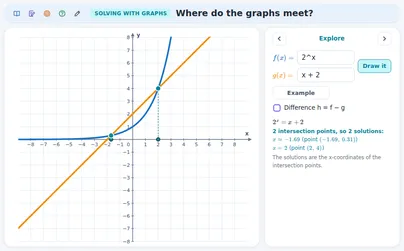
  5. eexponential: f(x)=axf(x) = a^x, with 0<a<10 < a < 1 or a>1a > 1
  6. ftrigonometric: f(x)=asin⁡(bx)f(x) = a\sin(bx); acos⁡(bx)a\cos(bx); tan⁡x\tan x

Syllabus: p. 41

← Back to the overview
E3.4ExtendedWork out a quadratic function's rule from given factsFully covered

Details

  1. avertex and another point
  2. bits x-axis crossings plus one other point
  3. cits vertex or x-intercepts, when the leading coefficient is 1

Syllabus: p. 42

← Back to the overview
E3.7ExtendedKnow and apply the following about logarithmsNo application yet

Details

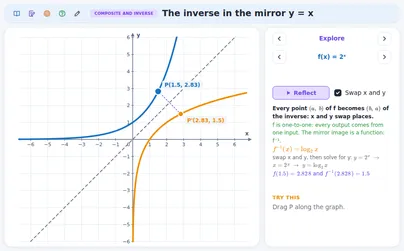
  1. b1logarithms undo exponentials, as their inverse function
  2. b2y=axy = a^x is equivalent to x=log⁡a(y)x = \log_a(y)
  3. b3the solution to ax=ba^x = b is x=log⁡blog⁡ax = \dfrac{\log b}{\log a}

There is no application for this outcome yet. It is taught as classroom work.

Syllabus: p. 42